Getting Started with Per Diem Imaging Work: Credentials, Licensing, First Shift
Last updated July 22, 2026
To start per diem imaging work, make sure your ARRT certification, state license, and BLS are current, then verify your profile once on a staffing platform. After verification, browse open shifts by modality and location, request the ones that fit, and arrive early for a short site orientation before your first patient.
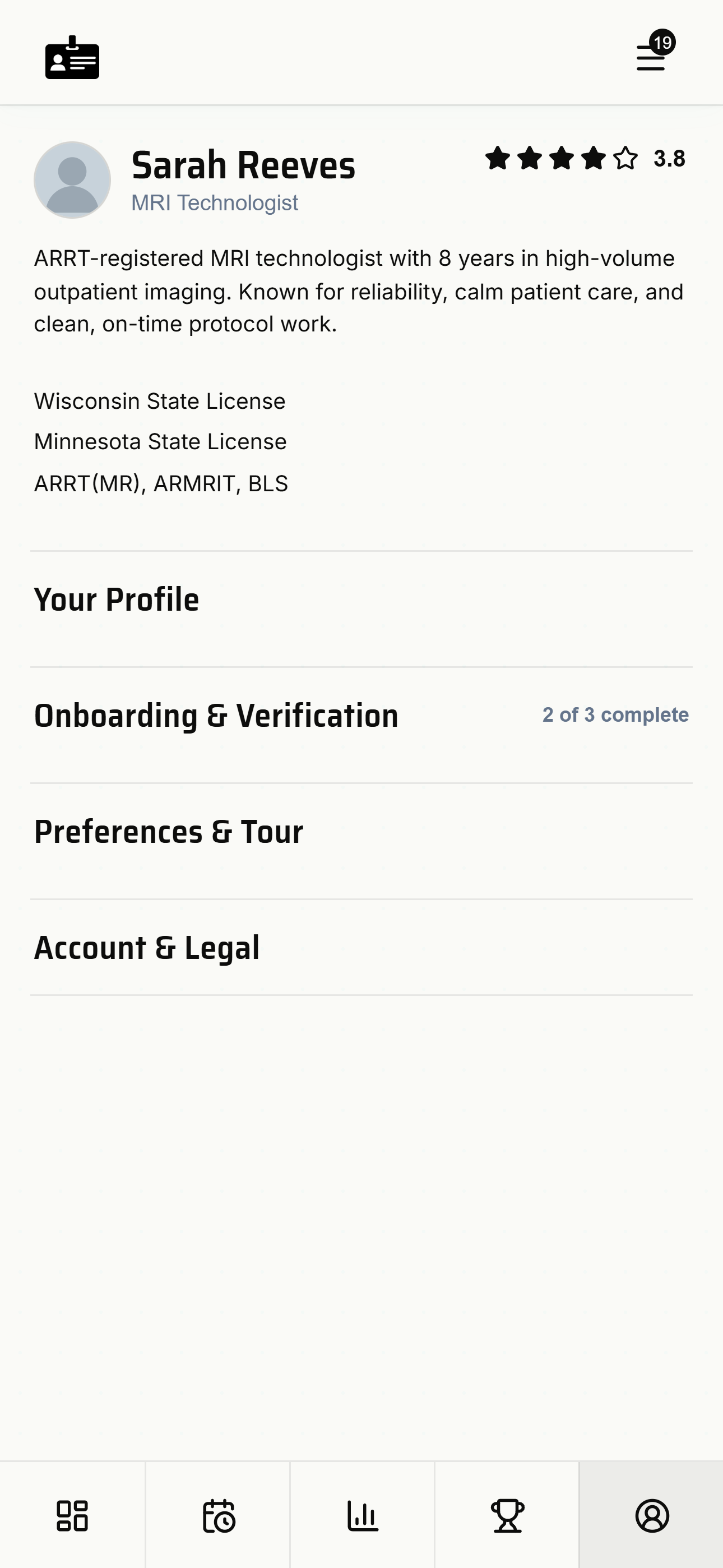
Moving into per diem imaging is less about a single big decision and more about working through a short, practical checklist in the right order. This guide walks through each step, from confirming your credentials and gathering documents to building a verified profile, requesting your first shift, and knowing what to expect when you walk in the door.
1. Get your credentials in order
Most imaging shifts require current certification and licensure before you can be booked. For many radiologic technologists the baseline is certification and registration through the American Registry of Radiologic Technologists (ARRT), a state license in every state where you intend to work, and a current Basic Life Support (BLS) card, most often the American Heart Association credential. State requirements vary, and a few states do not license technologists at all, so confirm the rule for each state on your list rather than assuming. Our state-by-state licensing reference is a starting point, though you should always verify with the board.
Modality determines what else you need. Beyond primary certification in radiography, the ARRT offers post-primary certifications in modalities such as computed tomography (CT), magnetic resonance imaging (MRI), and mammography, and a facility will expect the registry that matches the shift. For MRI, some sites also accept the American Registry of Magnetic Resonance Imaging Technologists (ARMRIT) credential. Sonography and nuclear medicine run on their own registries, such as ARDMS and NMTCB. Mammography carries additional federal requirements, and some states require separate permits for procedures such as fluoroscopy, so check both before you request that kind of shift.
2. Gather your documents
Verification and onboarding both go faster when your paperwork is already in hand. Before you build a profile, collect the following:
- Government-issued photo identification.
- Your ARRT card and any post-primary or modality registry documentation.
- State license or licenses for the states where you plan to work.
- Your current BLS card, front and back.
- Health records the facility may require, such as immunization history, a recent tuberculosis screening, and an annual influenza vaccination.
- Bank details for direct deposit and a resume or short work history.
3. Create and verify your profile
Once your credentials are current and your documents are gathered, you build a profile one time. On WhiteBadge, you add your licenses, certifications, and modality qualifications, and each item is verified against its source before you can request shifts. Completing this up front means a facility never has to re-check your paperwork, and you never resubmit it for each shift. It also means you only see shifts you already qualify to work.
4. Find shifts that fit
With a verified profile, you can browse open shifts filtered to what matters to you: modality, distance from home, pay, and date. Because the hourly rate is shown before you accept, you can compare shifts directly and choose the ones that fit your week instead of negotiating each one.Per diem, also called PRN, means there is no long-term commitment, so you decide how often to work. If you are still mapping the wider market, the best places to find rad tech jobs compares boards, networks, and imaging-specific platforms in one place.
5. Request and confirm a shift
When a shift looks right, you request it. The facility reviews the request and confirms, at which point the shift is booked. Booking one shift does not commit you to anything beyond that shift, and no long-term contract is attached. Once a shift is confirmed, review everything you will need on the day: the address, the entrance, parking, the start time, and any site notes included with the posting.
6. Work your first shift
Give yourself extra time on your first day at a new site. Arrive early, bring your identification and physical copies of your credentials even though they are already verified in the app, and check in wherever the posting directs, often a front desk or security point where you may be issued a temporary badge.
Report to the charge technologist, the lead running the department that shift, and let that person know it is your first time on site. A short orientation usually follows: where to find personal protective equipment, lead aprons, and supplies; how the local PACS and modality console are set up; how patients are transported and where you document; and what to do in an emergency or code. Every site runs its own protocols even for the same modality, so ask where they are kept and confirm who approves your hours before you leave.
Common first-timer mistakes to avoid
- Letting a credential lapse just before a shift. Track the renewal dates for your license and BLS well ahead of time.
- Arriving exactly at the start time with no room to find the department or get oriented.
- Assuming every site uses the same software and workflow. Ask about site-specific protocols instead of guessing.
- Leaving the parking, entrance, and check-in details until the morning of the shift.
- Leaving physical credentials and identification at home because they are verified digitally.
- Taking on tasks outside your credentialed modality or comfort level rather than asking the charge technologist.
After the shift: timesheets and pay
When the shift ends, your hours are submitted as a digital timesheet for the facility to approve. Once approved, payment is processed on a weekly cycle. Keeping your completed shifts and hours in one place also makes it easier to plan your schedule and to manage taxes, since many per diem technologists work as contractors rather than employees.
- Most imaging shifts require current ARRT certification, a state license where the state requires one, and current BLS.
- Modality shifts may require a matching registry, such as ARRT post-primary CT or MRI, or ARMRIT for MRI.
- Credentials and documents are verified once, up front, then reused for every shift you request.
- On your first shift you report to the charge technologist and complete a short site orientation before taking patients.
- The most common first-timer mistakes are a lapsed credential and arriving without time to get oriented.
- After the shift, hours are submitted as a digital timesheet and paid on a weekly cycle.