How Per Diem Work Works for Radiologic Technologists
Last updated July 23, 2026
Per diem radiologic technologists work imaging shifts one at a time, as needed, rather than holding a full-time staff position. You choose which posted shifts to accept, work them at the facility, and are paid by the hour. Credentials are verified up front, the rate is shown before you accept, and the work is often 1099 contract work.
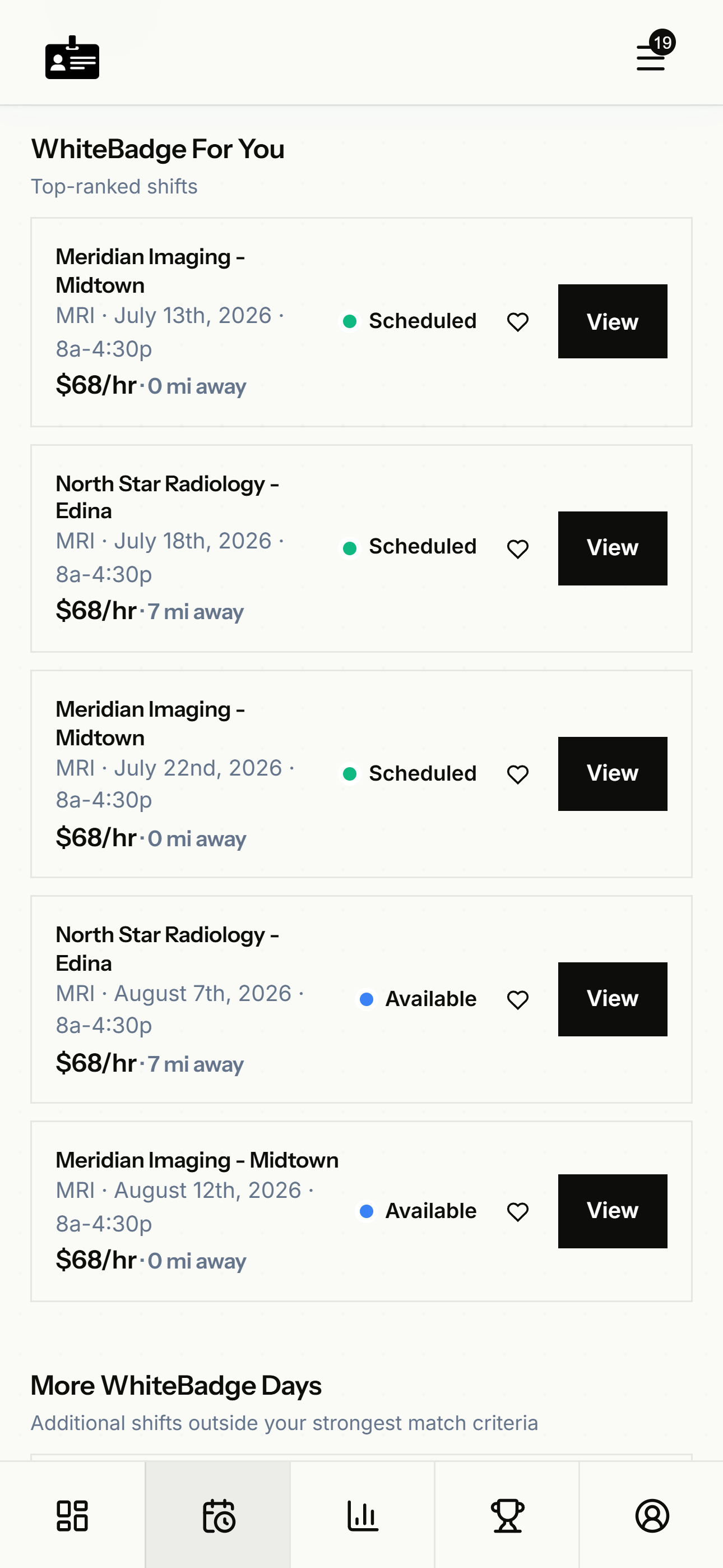
For radiologic technologists used to a salaried staff job, per diem runs on a different logic, and the details are worth understanding before you pick up a first shift. This guide walks through how per diem fits into medical imaging, what to expect from the shifts and the hourly pay, and how credentials, taxes, and benefits are handled when you work this way.
What per diem means in medical imaging
The phrase per diem is Latin for “by the day.” In staffing, it describes work that is scheduled shift by shift, with no ongoing obligation on either side. For imaging specifically, a per diem technologist might cover a CT shift at a hospital one week and a radiography shift at an outpatient center the next. The defining features are flexibility and control: you decide when you are available and which shifts fit your life. Some technologists work per diem full time, while others use it to add a few shifts around a staff job.
Credentials you verify before picking up shifts
Per diem does not mean lower standards. Before you can request shifts, your credentials are checked and kept on file. For most radiologic technologists that includes ARRT registration, a state license where the state requires one, and current BLS certification. Modality matters as well: a facility posting a CT or MRI shift will expect the matching advanced registry, and a mammography shift carries its own regulatory requirements. Keeping licenses, certifications, and continuing education current is what keeps you eligible. On the WhiteBadge app, verification happens up front, so the only shifts you see are ones you already qualify for, and a facility knows that anyone able to request its shift meets its requirements.
How shifts work
A facility posts an open shift with the modality, date, hours, location, and rate. Available technologists review the details and request the shifts they want. Once the facility confirms, the shift is booked. Because there is no long-term contract, you can work as often or as little as you like, and you are never obligated to accept a shift you do not want.
Where per diem technologists work
Per diem shifts span a range of settings, and each one feels different on the floor. A hospital runs around the clock, sees higher-acuity cases, and may need coverage in the emergency department, in surgery with a C-arm, or on overnight and weekend rotations. An outpatient imaging center usually runs scheduled daytime hours with more routine exams and a steadier pace. Urgent care clinics, orthopedic practices, and surgical centers sit somewhere in between. Working across these settings broadens your experience, keeps you sharp on more equipment, and shows you which environments suit you.
What a per diem week can look like
A per diem week is assembled from individual shifts rather than a fixed rotation. One week might look like this:
- A daytime CT shift at a community hospital on Monday.
- An evening radiography shift at an outpatient imaging center on Wednesday.
- A twelve-hour overnight shift covering the emergency department on Saturday, which often carries a premium.
The following week could be lighter, heavier, or built around different facilities. You set the pace, and nothing carries over from one week to the next.
How pay works
Per diem shifts are paid by the hour at a rate shown before you accept, so there is no guessing what a shift is worth. Rates vary by modality, location, shift time, and demand. Weekend, overnight, and hard-to-fill shifts often pay more than routine daytime coverage. Onthe WhiteBadge app, completed hours are tracked for you and payouts run on a weekly cycle, which is faster than the pay schedule at many staff positions.
Taxes, benefits, and the 1099 question
Per diem work is often structured as independent contract work rather than employment, which changes how you handle pay. When you are paid as a contractor, your earnings are reported on a 1099 and no taxes are withheld for you. That means setting aside part of every payment for federal and state taxes, covering self-employment tax, and often sending the IRS estimated payments through the year rather than settling up once. The trade is that legitimate business costs, such as license and certification renewals, continuing education, liability insurance, and mileage between facilities, may be deductible. Benefits follow the same logic: without an employer plan, you arrange your own health coverage and retirement savings. Because classification depends on the arrangement, it is worth confirming how a given shift is paid, and many technologists new to contract work consult a tax professional early on.
How to evaluate a shift before you accept it
Because you choose each shift, it helps to weigh a few things before you confirm:
- Modality and scope: confirm the exam types match your credentials and your comfort level.
- Rate against travel: a strong rate can be offset by a long commute, so weigh both together.
- Facility and acuity: a trauma emergency department and a quiet outpatient center make for very different days.
- Time and length: check the start time and shift length against the rest of your week.
- Logistics: parking, badge access, the imaging systems in use, and any required orientation all shape how the shift goes.
Reading the full posting before you request it is the simplest way to avoid surprises.
Per diem versus a staff position
A staff role offers a predictable schedule, a set salary, and employer benefits such as health insurance and paid time off. Per diem trades some of that predictability for flexibility and, often, a higher hourly rate, because the facility is paying for coverage without the overhead of a permanent hire. Neither model is better in the abstract. Per diem tends to suit technologists who want to control their own schedule: parents balancing childcare, students, technologists nearing retirement who want to stay active without full-time hours, and staff technologists picking up occasional shifts for extra income. The right choice depends on what you value most. And if a listing says PRN rather than per diem, the two labels mean the same thing.
- Per diem means working imaging shifts one at a time, as needed, with no long-term commitment.
- You choose which shifts to accept, and the hourly pay is shown before you accept.
- Credentials such as ARRT registration and a state license are verified up front, so you only see shifts you already qualify for.
- Weekly payouts are common, and overnight or hard-to-fill shifts often pay more.
- Per diem is often paid as 1099 contract work, so you set aside your own taxes and arrange your own benefits.