What Per Diem Coverage Costs an Imaging Department
Last updated July 22, 2026
Per diem coverage costs an imaging department the technologist's hourly pay rate plus a margin added by whoever arranges the shift. A traditional agency adds a larger markup and often requires contracts or minimums, while a direct marketplace narrows that margin. Time-to-fill, cancellations, and re-credentialing add real costs beyond the hourly rate.
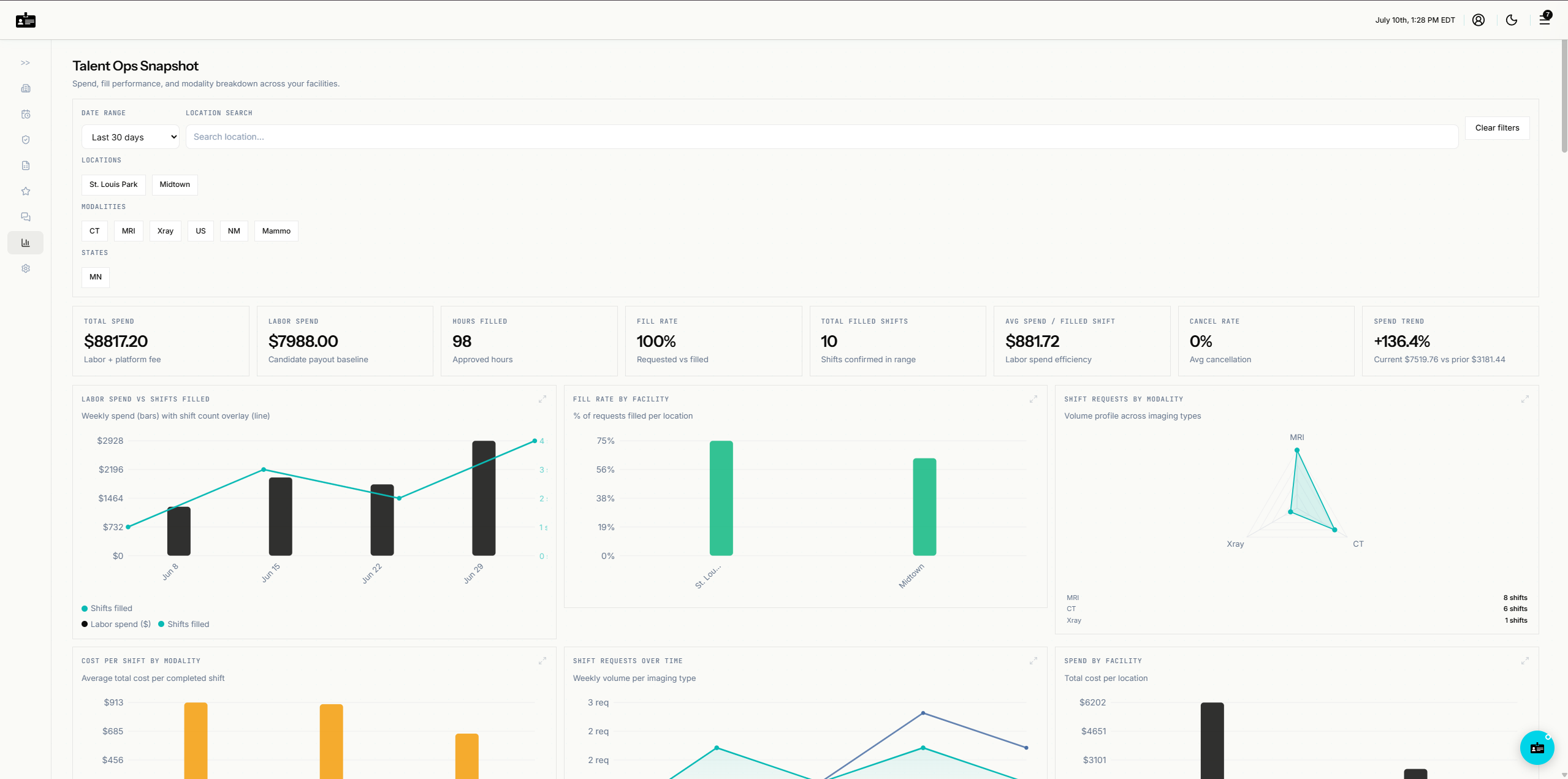
Choosing how to cover a per diem shift is really a question of cost and reliability together. Before weighing an agency against a direct marketplace, it helps to see what goes into the price of coverage in the first place, from what the technologist earns to the overhead layered on top. The sections below walk through each component and then set the two models side by side.
What goes into the cost of coverage
Every filled per diem shift, also called PRN coverage in many departments, has a pay rate, meaning what the technologist earns, and a bill rate, meaning what the department pays. The difference between the two is the margin. That margin covers sourcing candidates, verifying credentials, running payroll and billing, carrying liability, and profit for whoever arranges the work.
The base rate is only the starting point. Coverage can also carry overtime when a shift pushes a worker past a weekly hour threshold, premiums for overnight, weekend, or holiday hours, and surcharges when a shift is booked at short notice. Modality matters as well, because the rate for a general radiographer differs from the rate for MRI, CT, mammography, or interventional work, where the pool of qualified technologists is smaller.
The traditional agency model
In the traditional model, a staffing agency sources and vets technologists, then places them at a facility for a markup. That markup is often substantial, and agencies frequently work in longer contracts or weekly minimums rather than single shifts. The department gains a managed relationship and a single point of contact, but it pays for the layers of overhead built into the bill rate, it has limited visibility into how much of that rate reaches the technologist, and a minimum can mean paying for hours it did not strictly need.
The direct-marketplace model
A direct marketplace connects the department with local, credential-verified technologists without the agency layer in the middle. The facility posts a shift, sees a suggested rate drawn from market data, and books from technologists who have already been verified. Because there are fewer intermediaries, more of the bill rate reaches the technologist and the margin added on top is smaller. Coverage can be arranged shift by shift rather than in long contracts, which matches spending to actual need. The trade-off is that the department handles more of the coordination directly instead of routing it through an account manager.
The two models side by side
Consider filling the same weekend CT shift two ways. Neither option is automatically cheaper on the hourly rate alone, so the honest comparison weighs the all-in bill rate against how reliably each one actually fills the shift.
- Through an agency: a larger margin, a possible weekly minimum, one managed contact, and less visibility into the technologist pay rate.
- Through a marketplace: a smaller margin, single-shift booking, a direct choice of technologist, and a visible rate, in exchange for coordinating the booking in house.
The hidden costs the hourly rate does not show
The hourly rate is only the visible part of what coverage costs. Several other costs sit underneath it and rarely appear as a line item.
- Time-to-fill: an open shift that lingers ties up management time and risks patient delays.
- Cancellations and no-shows: a confirmed technologist who does not appear leaves a gap that is expensive to close at the last minute.
- Credentialing and onboarding: verifying paperwork repeatedly is slow, and orienting a new face to the department each time adds administrative hours.
- Coordination: every call, message, and follow-up spent chasing coverage is unbilled labor that still has a cost.
The downstream cost of an unfilled shift
When a shift goes unfilled, the cost does not disappear. It moves downstream to patients and to revenue. A rescheduled scan delays a diagnosis, frustrates the patient, and can send a referral elsewhere. A scanner that sits idle still carries its fixed cost, and support staff scheduled around that room may wait with little to do. None of this shows up on a staffing invoice, yet it favors whichever model fills shifts reliably.
A checklist for comparing coverage options
To compare options honestly, a manager can ask the same questions of every source of coverage, agency or marketplace, and line up the answers.
- What is the all-in bill rate per hour, including every fee and premium?
- What share of that rate reaches the technologist?
- Is there a minimum, a contract length, or a cancellation fee?
- How quickly does a posted shift usually fill?
- How often do confirmed shifts fall through?
- Are credentials verified once, or re-checked on every booking?
- Can the department see and choose the technologist before the shift?
- Who absorbs the cost when a booked technologist cancels?
Reading the full picture
Look past the sticker rate. Compare the all-in bill rate, the share of that rate that reaches the technologist, how reliably shifts get filled, and how often confirmed shifts fall through. If the comparison ends at a permanent hire instead of ongoing coverage, where to post radiologic technologist jobs walks through the channels for that role. A slightly higher pay rate that comes with a smaller margin, faster fills, and fewer cancellations can be the lower-cost choice once the full picture is counted, and you can book a demo to see how WhiteBadge covers your shifts.
- A per diem shift costs the technologist pay rate plus the margin added to arrange it.
- Traditional agencies add a larger markup and often require contracts or weekly minimums.
- A direct marketplace shrinks the gap between the bill rate and the pay rate.
- Time-to-fill, cancellations, and re-credentialing are real costs beyond the hourly rate.
- An unfilled shift pushes cost downstream to rescheduled patients and idle equipment.
- Compare the all-in bill rate and fill reliability together, not the hourly rate alone.