Handling Technologist Call-Outs Without Losing the Day
Last updated July 22, 2026
An imaging department handles a same-day technologist call-out by triaging the schedule to protect urgent and hard-to-reschedule exams, then filling the open modality from a pre-verified pool of per diem technologists before it cancels patients. Because coverage is limited by modality and credential, the faster a credential-matched technologist is confirmed, the more of the day stays intact.
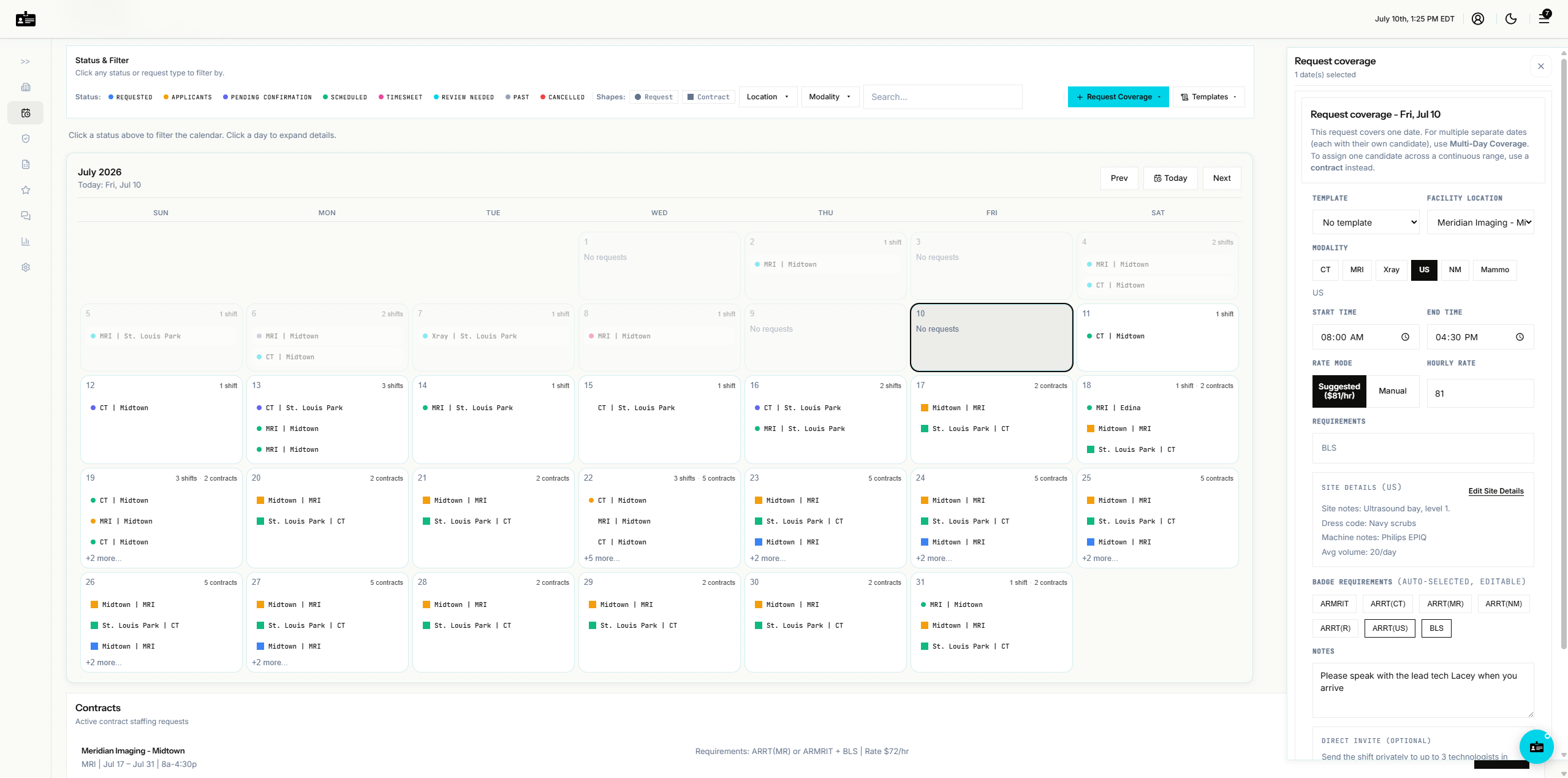
A technologist calling out on the morning of a shift is one of the more stressful moments in running an imaging department, but it does not have to derail the day. The difference between a lost day and a manageable one usually comes down to preparation and a clear order of operations. What follows is a practical approach, from triaging the schedule to reaching a pre-verified bench and communicating with the patients affected.
Why technologists call out, and why imaging is hard to cover
Call-outs are a normal part of running a department. People get sick, care for children or parents, face emergencies, and sometimes burn out during short-staffed stretches. What makes imaging harder to cover than many other departments is that a missing technologist cannot always be replaced by any available colleague. Coverage is constrained by modality and credential. A general radiographer is not automatically qualified to run a CT scanner, an MRI suite, a mammography unit, an interventional room, or a nuclear medicine study, because each requires its own advanced registry, and mammography carries its own regulatory requirements. So when the one credentialed MRI technologist on the schedule calls out, the department cannot simply pull someone from the radiography floor. The pool of people who can legally and competently step in is small, and on a given morning it may be empty.
The usual scramble, and what it costs
The traditional response to a call-out is a scramble. A lead technologist or manager starts working the phone, calling part-time staff, asking a scheduled technologist to stay past the end of a shift, offering overtime, or pulling a cross-trained colleague from another modality. When none of that closes the gap, the last resort is cancelling or rescheduling patients. Each move carries a cost. Overtime is expensive and, repeated often, drives the fatigue that causes more call-outs. Cross-covering can stretch a technologist beyond the modality where they are strongest. Leaning on the same reliable people every time quietly burns them out. And every cancelled appointment delays a patient's diagnosis while an expensive scanner sits idle. The scramble also consumes the manager's morning, the hours that should have gone to running the department.
Triage: deciding which appointments to protect first
When coverage is thin, not every appointment can be treated as equal, so the first practical step is triage. Sort the day by clinical urgency and by how hard each exam is to move. Inpatient and emergency studies, exams tied to a same-day surgical or oncology decision, time-sensitive contrast studies, and appointments a patient has traveled a long way for should be protected first. Routine screening and follow-up exams that reschedule cleanly are the ones to move if something has to give. Triaging early, rather than after the phone calls have failed, means that partial coverage is aimed at the appointments that matter most.
Building a bench of credential-verified per diem technologists
The most durable fix is to have qualified people to call before the day arrives. A standing bench of per diem, or PRN, technologists gives a department rapid backup that is already vetted. Its value depends entirely on credentials being current and verified in advance. When licensure, ARRT registration, modality registries, and competencies are confirmed ahead of time and kept on file, a manager can offer an open shift and trust that anyone who accepts is ready to work that specific modality. When verification has to happen in the moment, the bench is far slower to use. This is where a marketplace of credential-verified technologists helps, because it maintains verification continuously, so same-day outreach reaches people who already qualify for the open shift.
Coverage protocols worth having in place
A department covers call-outs more calmly with layered protocols rather than a single fallback. A few that work well together:
- A float pool: technologists cross-trained across modalities who can be redirected to the day's greatest need.
- An on-call rotation: a scheduled technologist, often for higher-acuity or overnight work, who can be activated on short notice.
- A per diem bench: local, pre-verified technologists a manager can reach directly for a single shift.
- A marketplace request: posting the open shift to a wider pool of verified technologists when internal options are exhausted.
The point of layering is that no single mechanism has to carry every gap. When the float pool is committed and the on-call technologist is unavailable, a marketplace request widens the search instead of ending it.
Communicating with patients and referrers
Once the coverage picture is clear, communication limits the damage from whatever cannot be covered. Patients whose appointments must move should be contacted as early as possible, offered a real next available slot, and told plainly why the change is happening. For an exam tied to a referring provider's treatment decision, the referrer or their office should hear about the delay directly, so they can adjust their plan and flag anything that genuinely cannot wait. Handling this early protects the patient relationship and keeps referrers confident in the department long after the difficult morning has passed.
Preventing the next call-out from becoming a crisis
A single call-out will always happen; a lost day does not have to follow. Prevention is mostly about removing single points of failure. Cross-train technologists across modalities where it is safe and appropriate, so one absence does not close a service line. Keep the per diem bench active and its credentials current rather than letting it go stale between emergencies. Watch the schedule for thin spots, a modality that depends on one person, or a shift that is chronically hard to fill, and build redundancy there first. Tracking how often call-outs happen and how each was covered lets the response improve over time instead of starting from zero. And if a chronically thin spot points to a permanent seat rather than more coverage, where to post radiologic technologist jobs compares the posting channels facilities use.
Turning a call-out into a procedure
Handled well, a same-day call-out becomes a procedure rather than an emergency. Triage the schedule, protect the exams that cannot wait, reach a pre-verified bench before cancelling anyone, and communicate early about whatever must move. A department that has prepared keeps most of its day intact on the morning a technologist cannot come in, and you can book a demo to see how WhiteBadge fills a same-day gap.
- A same-day call-out is covered fastest when a department can reach pre-verified per diem technologists instead of starting the search from scratch.
- Imaging coverage is limited by modality: a general radiographer cannot cover an MRI, CT, or mammography shift without the matching credential.
- The traditional scramble of calling around, paying overtime, and cross-covering is slow and wears down the remaining staff.
- Triaging the schedule to protect urgent and hard-to-reschedule exams keeps the most important appointments when coverage is thin.
- Layered coverage, a float pool, an on-call rotation, a per diem bench, and a marketplace request, avoids a single point of failure.
- Early, honest communication with patients and referrers limits the damage when an exam has to move.