Working Per Diem Around a Full-Time Tech Job
Last updated July 27, 2026
Yes, a full-time radiologic technologist can usually work per diem on the side, but only after confirming that an employment agreement or handbook does not restrict outside work through non-compete or exclusivity clauses. The main challenges are scheduling around your rotation, protecting rest between shifts, and handling the tax effect of a second income.
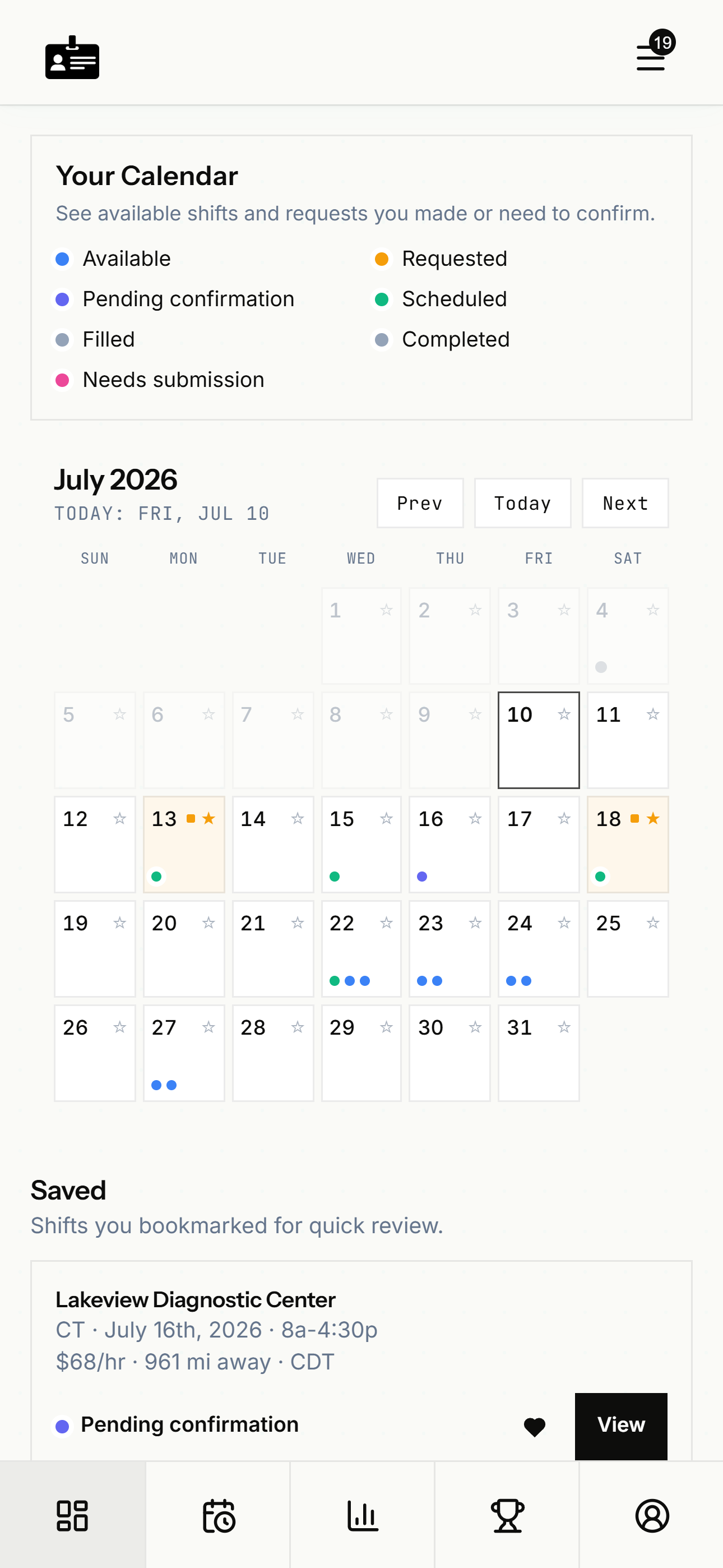
Plenty of staff technologists want to pick up per diem shifts for extra income or variety without giving up the stability of a full-time role, and in most cases the two can coexist. The catch is that the answer depends on your own contract and on how carefully you manage rest and taxes, not on a single rule that applies to everyone. This guide walks through what to check and how to add shifts without undermining your primary job.
Check whether your employer allows it
Before you request a single per diem shift, read your employment agreement and the employee handbook for anything that governs outside work. Employers differ widely: some permit moonlighting freely, some require written approval in advance, and some restrict it. Because the rules live in your own paperwork rather than in a universal standard, the only reliable answer comes from reading your documents and, where the language is unclear, asking human resources in writing.
Non-compete, exclusivity, and conflict-of-interest clauses
Pay particular attention to a few specific clauses. A non-compete or exclusivity clause may limit where and for whom you can work, and a conflict-of-interest clause may bar you from working for a competing facility within a certain distance or during your employment. Enforceability of these terms varies by state and by role, so do not assume a clause is either automatically valid or automatically void. If your contract contains restrictive language, confirm what it actually covers before you accept outside shifts, and consider professional advice for anything ambiguous. This article is educational and is not legal advice.
Schedule per diem around your full-time rotation
The scheduling challenge is fitting per diem work into the gaps left by a full-time rotation without colliding with it. Map your primary schedule first, including any on-call obligations, then look for per diem shifts that fall on genuine days off. Per diem, also called PRN, is built for exactly this flexibility, because you choose each shift rather than committing to a recurring block. Leave a buffer between a per diem shift and your next scheduled shift at your main job, so that one shift running long does not leave you arriving late or exhausted to the other.
Protect rest and treat fatigue as a patient-safety issue
In imaging, fatigue is not only a personal cost but a patient-safety concern, because tired hands and a tired mind raise the chance of positioning errors, protocol mistakes, and lapses in radiation safety. Guard your sleep as deliberately as you guard your calendar. Avoid stacking a per diem night shift directly against a full-time day shift, watch for the slow accumulation of back-to-back days without real recovery, and be honest about the point at which added income is no longer worth degraded performance. If a shift would leave you working while genuinely impaired by lack of sleep, decline it.
Understand the second-income tax picture
A second income changes your tax situation, and how it is taxed depends on how you are engaged. Per diem work may be paid as a W-2 employee of a staffing arrangement or as a 1099 independent contractor, and the distinction matters. As a 1099 contractor, taxes are generally not withheld for you, which means you are responsible for setting money aside yourself and may owe estimated taxes during the year. Stacking a second income on top of full-time wages can also push part of your earnings into a higher bracket, so the amount to reserve is often more than first-timers expect. Confirm how each shift is classified, and set aside a portion of every per diem payment before you spend it.
Track mileage and expenses from the start
If any of your per diem work is paid on a 1099 basis, keeping clean records from your first shift makes tax time far easier and can reduce what you owe. Depending on your classification and current tax rules, expenses tied to contract work may be deductible. Keep a simple record as you go rather than reconstructing one later:
- Mileage and dates for travel connected to per diem shifts.
- Records of license, certification, and continuing-education costs.
- Receipts for required equipment, lead markers, or dosimetry not supplied by a site.
- A separate record of per diem income, kept apart from your W-2 wages.
A dedicated account or a single spreadsheet, updated after each shift, is usually enough. For how deductions apply to your specific situation, a qualified tax professional is the right source.
Choose per diem shifts that actually fit
Not every open shift is worth taking once you already work full time, so filter deliberately. Weigh three factors together:
- Distance. A long commute eats into rest and raises cost, so a nearer shift at a slightly lower rate can net out better than a distant one.
- Modality. Shifts that match a modality you already work daily, such as CT or MRI, carry the least additional mental load because the workflow is already familiar.
- Pay. Because the rate is visible before you accept on WhiteBadge, you can compare shifts directly and pass on any that are not worth the time.
The best side shifts are close to home, within a modality you know well, and priced so the trade against your rest is clearly worth it.
Start small and build from there
Begin with a single shift, not a full second schedule. One per diem shift in a pay period lets you see how the added work affects your sleep, your performance at your main job, and your finances before you take on more. Add shifts gradually, and only while your rest and your primary role stay intact. Because per diem carries no long-term commitment, you can scale up in a strong month and pull back in a demanding one, keeping your full-time position as the stable base and per diem as the flexible layer on top.
- Whether you can work per diem while employed full time depends on your own employment agreement and employee handbook, not on a universal rule.
- Non-compete, exclusivity, and conflict-of-interest clauses are the contract terms most likely to restrict outside shifts, and their enforceability varies by state.
- Per diem, also called PRN, carries no long-term commitment, so individual shifts can be scheduled around a full-time rotation.
- Fatigue in imaging is a patient-safety issue, so rest between shifts should be protected as deliberately as the schedule itself.
- Per diem may be paid as W-2 or as 1099 income; 1099 pay usually has no tax withheld, so money must be set aside and estimated taxes may apply.
- Starting with a single shift per pay period lets you test the effect on rest, performance, and finances before adding more.